Gemini 4 Argon vs Muse Wonder: Which Runs MCP Tools Better?
Nikhil Tiwari
MCP Playground
📖 TL;DR
- Muse Wonder (Meta, Oct 12) and Gemini 4 Argon (Google, Oct 13) are both 1M-context reasoning models built for long agent tasks.
- Neither has an MCP-Atlas score yet. Every number in the launch posts is the vendor's own, and the two tables mostly use different harnesses.
- On the one row both vendors report the same way, DeepSWE 1.1, they are close: Wonder 78.8%, Argon 77.9%, Claude Opus 5.5 at 74.2%.
- Argon's standout is safety: 0.7% prompt-injection success on Gray Swan by Google's figure. That matters when your tools return text you did not write.
- Both are in MCP Agent Studio at 15 credits a run, the same as Opus 5.5. Run all three against your server and compare.
Table of Contents
- Gemini 4 Argon vs Muse Wonder: the spec sheet
- Do the benchmarks predict MCP tool calling?
- Tool calling parameters that differ
- Both models stop and ask. Is your harness ready?
- Prompt injection and untrusted MCP servers
- What each model costs per MCP run
- Hands-on results on real MCP servers
- Which one should you pick for MCP?
- FAQ
Meta shipped Muse Wonder on October 12. Google shipped Gemini 4 Argon the next day.
Both launch posts say the same thing. This model is built for long, multi-step agent work.
For anyone running Model Context Protocol servers, that means tools. A model that plans across twenty tool calls is the whole job.
So the Gemini 4 Argon vs Muse Wonder question I care about is narrow. Which one calls my MCP tools correctly, and fails safely when it does not?
Neither launch answers that. There is no MCP-Atlas score for either model yet. The benchmark tables also measure different things.
I went through both launch posts and the OpenRouter listings. I also checked the parameters each API actually accepts.
Below is what is comparable, what is not, and the two behaviour changes most likely to break an existing harness.
Skip this and you may pick a model on a benchmark that never touched a tool call.
Gemini 4 Argon vs Muse Wonder: The Spec Sheet
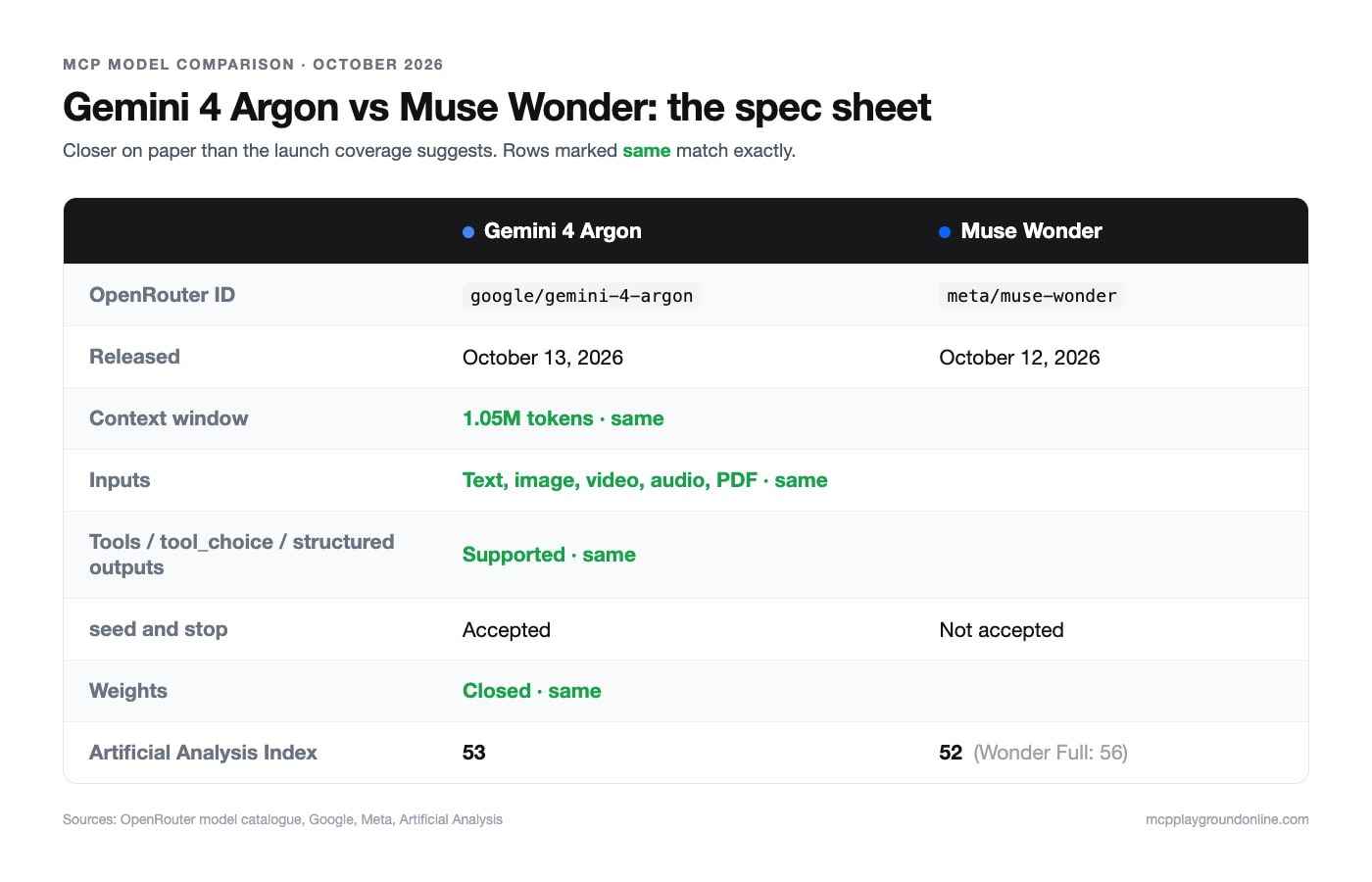
Start with the specs. On paper these two are closer than the launch coverage suggests.
| Spec | Gemini 4 Argon | Muse Wonder |
|---|---|---|
| OpenRouter ID | google/gemini-4-argon |
meta/muse-wonder |
| Released | October 13, 2026 | October 12, 2026 |
| Context window | 1.05M tokens | 1.05M tokens |
| Max output (OpenRouter) | 64K tokens | No small cap listed |
| Inputs | Text, image, video, audio, PDF | Text, image, video, audio, PDF |
| Reasoning levels | Low, medium, high | Via reasoning_effort; scores measured at max |
| Weights | Closed | Closed |
| Artificial Analysis Intelligence Index | 53 | 52 |
Same window, same five input types, one point apart on Artificial Analysis. For reference, Claude Opus 5.5 scores 58 on that index.
One naming trap first. Meta also launched Muse Wonder Full, a stronger model that scores 56 on the same index.
Full is only for Muse Code subscribers. The API and OpenRouter serve plain Wonder. Many launch headlines quote Full, so check which column you are reading.
Want the model-by-model detail? I wrote up Gemini 4 Argon for MCP and Muse Wonder for MCP separately.
Do Gemini 4 Argon and Muse Wonder Benchmarks Predict MCP Tool Calling?
Mostly not. Neither launch reports MCP-Atlas, the Scale AI benchmark built on real MCP servers and tools.
That is the number I would want. Without it, I am reading proxies.
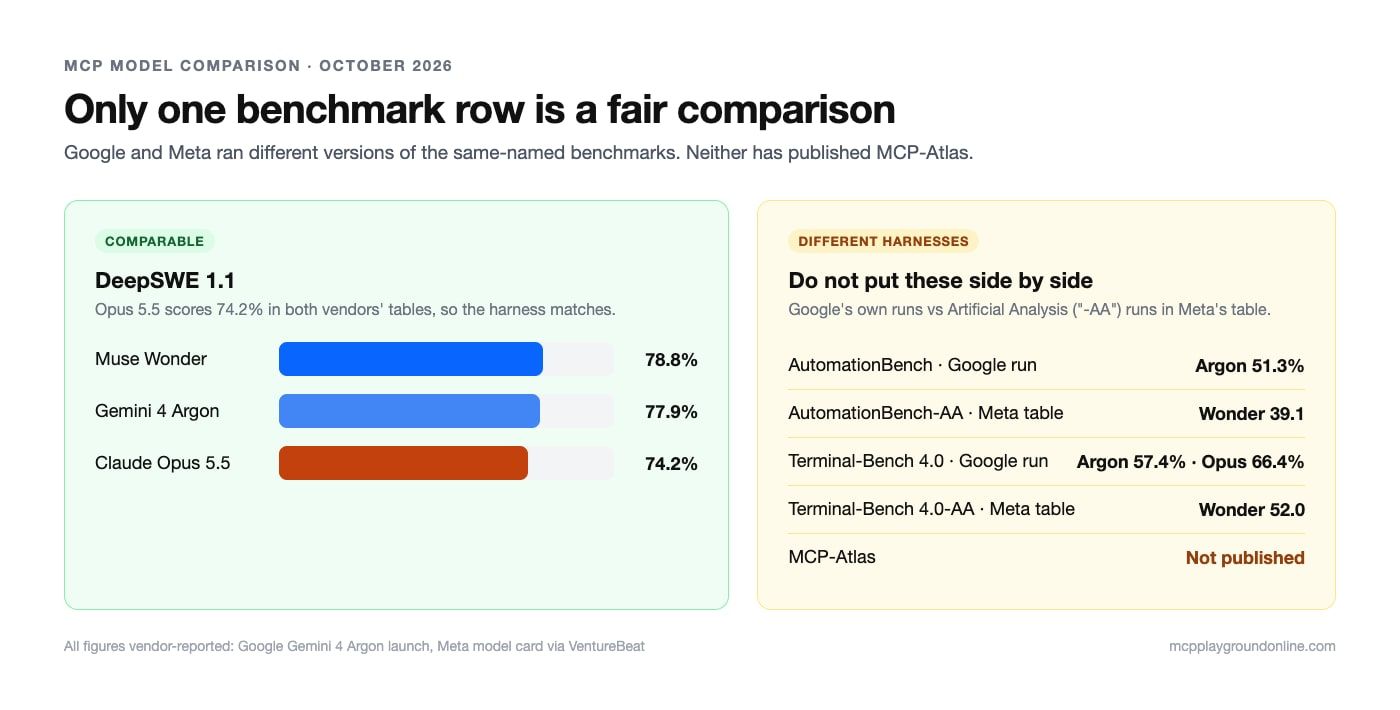
Worse, the two vendors ran different versions of the same-named benchmarks. Google reports AutomationBench and Terminal-Bench 4.0. Meta reports the Artificial Analysis runs, suffixed "-AA".
Those are different harnesses. Putting Google's 51.3% next to Meta's 39.1 compares two rulers, not two models.
Here is everything, with the source of each column made explicit:
| Benchmark | Gemini 4 Argon | Muse Wonder | Claude Opus 5.5 |
|---|---|---|---|
| DeepSWE 1.1 | 77.9% (Google) | 78.8% (Meta) | 74.2% (both tables) |
| AutomationBench (Google run) | 51.3% | Not reported | 42.5% |
| AutomationBench-AA (Meta table) | Not in Meta's table | 39.1 | — |
| Terminal-Bench 4.0 (Google run) | 57.4% | Not reported | 66.4% |
| Terminal-Bench 4.0-AA (Meta table) | — | 52.0 | — |
| MCP-Atlas | Not published | Not published | — |
DeepSWE 1.1 is the only clean row. Both tables give Opus 5.5 the same 74.2%, which suggests the same harness. Wonder leads Argon by under a point.
The Terminal-Bench gap matters more for MCP. Opus 5.5 beats Argon by nine points on Google's own table.
If your MCP server wraps a shell, a dev box or a CI runner, that is your closest proxy. Do not let Argon's workflow score stand in for it.
Argon's strength is the opposite shape: business workflows. That suits servers like CRMs, ticketing and payments, where each call is a structured form fill.
For the broader ranking across model families, see the best AI model for MCP tool calling.
Gemini 4 Argon vs Muse Wonder: Tool Calling Parameters That Differ
Both accept tools, tool_choice and structured_outputs on OpenRouter. So any MCP client that converts tools into function calls works with both.
The differences are in the knobs around the call. These are the ones that bite in a test harness:
- Seed. Argon accepts
seed. Wonder does not. You cannot make Wonder runs repeatable, so run each prompt more than once before calling something a regression. - Stop sequences. Argon accepts
stop. Wonder does not. A harness that ends turns on a stop string gets no effect on Wonder. - Parallel tool calls. Neither lists
parallel_tool_calls. A client expecting several calls in one turn may see them arrive one at a time. - Sampling. Wonder adds
top_kandrepetition_penalty. Argon does not list either. - Reasoning effort. Both take
reasoning_effort. Both vendors measured at high or max, so a run at default is not the model on the benchmark table.
That last point catches people. A disappointing first run at default effort says little about either model.
Meta's own API is also compatible with OpenAI and Anthropic tooling. Google's Gen AI SDKs can pass an MCP session in as tools, per the Gemini function calling docs.
Before blaming a model, confirm the server itself is clean. Test any MCP server free → and check the handshake and tool schemas first.
Both Models Stop and Ask. Is Your MCP Harness Ready?
Here is the behaviour change I would test first. Both models are trained to pause before consequential actions.
Google says Argon will pause for human confirmation before taking irreversible steps. Meta says Wonder's agents can ask permission before consequential actions.
On a server with delete_record or refund_payment, that is exactly what you want.
The problem is unattended runs. Your loop may end on a question instead of a tool call.
Many harnesses treat "the model replied in text" as "the task is done". Your evals will then count a polite pause as a failure.
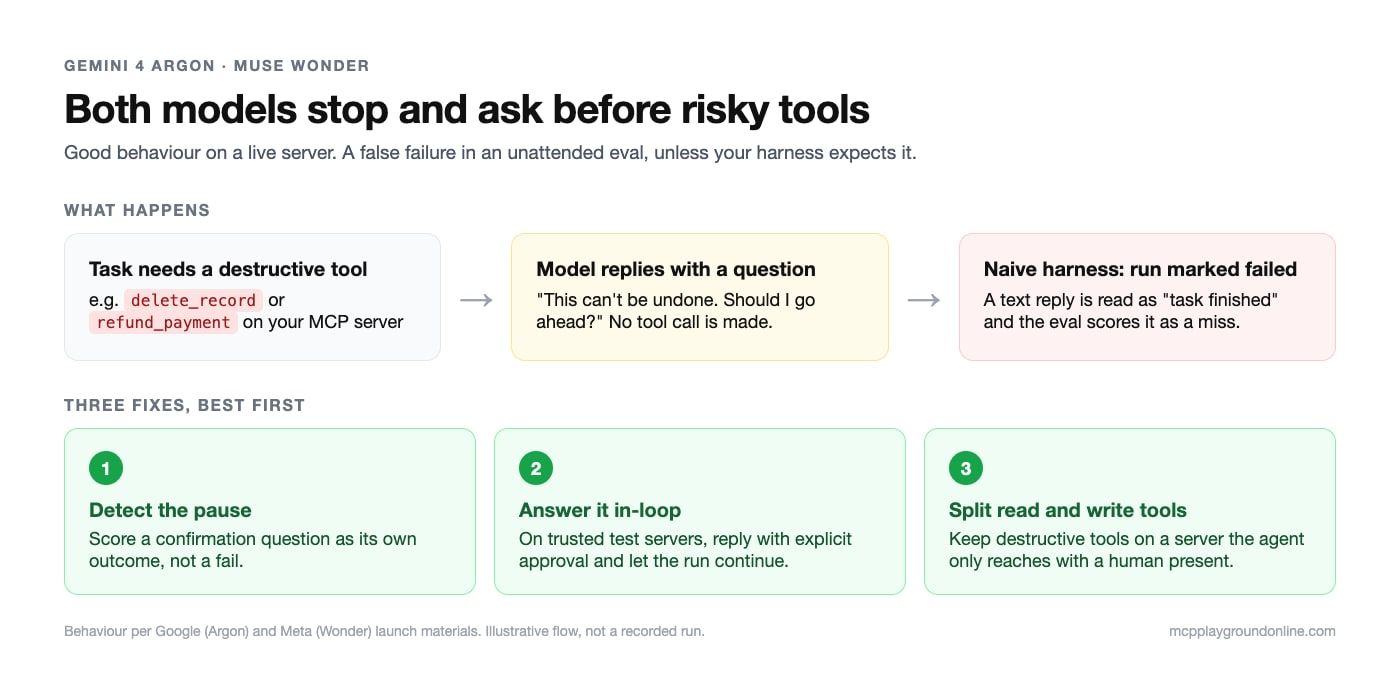
Three fixes, in order of how well they work:
- Detect the pause. Treat a confirmation question as its own outcome in your evals, not a fail.
- Answer it in-loop. For trusted test servers, reply with an explicit approval and let the run continue.
- Separate read and write tools. Keep destructive tools on a server the agent only reaches with a human present.
Meta adds two more behaviours. Active Focus keeps an agent working after an obstacle. Active Memory carries context across conversations.
Active Focus is worth testing on error paths. Persistence after a failed tool call is good. Persistence that retries a broken call ten times is not.
Gemini 4 Argon, Muse Wonder and Prompt Injection Through MCP Tools
Every MCP tool result is text the model reads and trusts. If a tool returns content you did not write, it can carry instructions.
A scraped web page. A support ticket. A GitHub issue body. Each is a way in for indirect prompt injection.
Google's headline safety figure targets exactly this. Argon's attack success on Gray Swan's indirect injection benchmark is 0.7%, across 15 adaptive attempts.
Google also says coding shortcut attempts dropped to 2%. That is the model gaming a test instead of solving it.
Meta did not publish a comparable injection figure for Wonder at launch. That is a gap, not evidence of weakness. It simply has not been reported.
Even 0.7% is not zero. A model is not a security boundary. Scope tokens tightly and keep write tools behind checks your server enforces.
The MCP prompt injection guide covers the server-side controls. You can also scan your MCP server → for injection paths in tool descriptions.
What Gemini 4 Argon and Muse Wonder Cost Per MCP Run
List prices look different today. They will not by December.
- Muse Wonder: $4 per million input tokens, $20 per million output. Cached input is $0.20.
- Gemini 4 Argon: $2 in, $10 out, with cached input 95% off. That is an introductory price.
Google's footnote says the introduction ends November 30, 2026. After that Argon is $4 in, $20 out, the same as Wonder.
For an MCP loop, cached input is the line that scales. Every turn resends your system prompt, tool schemas and history.
If you are benchmarking cost this month, use the December price. Otherwise your numbers flip in six weeks.
Hands-On Results: Gemini 4 Argon vs Muse Wonder on Real MCP Servers
Runs in progress. I am running the tasks below in Agent Studio against the public mock servers. This table fills in as results come in. Until then, nothing here is a measurement.
Here is the test plan. Same prompt, same server, same reasoning effort (high), three runs per model.
| Task (mock server) | Gemini 4 Argon | Muse Wonder | Claude Opus 5.5 |
|---|---|---|---|
Four-step chain: create_user_profile → process_order → analyze_data → configure_workflow (complex-schema) |
Pending | Pending | Pending |
| Schema-valid arguments on first try (complex-schema) | Pending | Pending | Pending |
Partial failure: reports which step failed (simulate_partial_success, error-simulation) |
Pending | Pending | Pending |
| Retries a failed call with corrected arguments (error-simulation) | Pending | Pending | Pending |
| Pauses to confirm before a destructive tool | Pending | Pending | Pending |
Every task uses the public mock MCP servers, so you can reproduce any row yourself.
The partial-failure row is the one I care about most. Google says Argon reports negative findings honestly.
Meta says Wonder keeps going after obstacles. Those two claims pull in opposite directions.
Gemini 4 Argon vs Muse Wonder: Which Should You Pick for MCP?
On published numbers alone, neither wins outright. They lean towards different server shapes.
| Your MCP server | Lean towards | Why |
|---|---|---|
| Business workflows (CRM, tickets, payments) | Gemini 4 Argon | Google's strongest row is AutomationBench |
| Tools that return untrusted text | Gemini 4 Argon | Only one with a published injection figure (0.7%) |
| Long coding tasks through repo tools | Muse Wonder | Edges DeepSWE 1.1, 78.8% to 77.9% |
| Shell, terminal or CI tools | Claude Opus 5.5 | Leads Terminal-Bench 4.0 by nine points over Argon |
| Evals that need repeatable runs | Gemini 4 Argon | Accepts seed; Wonder does not |
My honest default: run all three against your own server before choosing. The published gaps are small, and your tool schemas decide more than any leaderboard.
If you want the older models in each family for contrast, see testing MCP with Gemini models and testing MCP with Meta Muse models.
How MCP Playground Helps
This is the comparison MCP Playground is built for. Connect any MCP server in the browser and pick Gemini 4 Argon, Muse Wonder or Claude Opus 5.5.
You see every tool call with its real input and output. All three cost 15 credits a run, so the head-to-head is fair on price too. Server testing is free.
Frequently Asked Questions
Is Gemini 4 Argon or Muse Wonder better for MCP? Neither has an MCP-Atlas score yet. Argon leads on business workflows and prompt-injection resistance by Google's figures. Wonder edges it on DeepSWE 1.1. Test both on your server.
Do Gemini 4 Argon and Muse Wonder support tool calling? Yes. Both accept tools, tool_choice and structured_outputs on OpenRouter. Any MCP client that converts tools into function calls works with both.
What is the difference between Muse Wonder and Muse Wonder Full? Full is stronger, scoring 56 to Wonder's 52 on Artificial Analysis. Meta only serves plain Wonder through the API and OpenRouter.
Why did my agent stop and ask a question instead of calling a tool? Both models are trained to pause before irreversible or consequential actions. Treat the pause as its own outcome, or approve it in-loop for trusted servers.
How does Gemini 4 Argon compare to Claude Opus 5.5 for MCP? Argon leads on Google's AutomationBench and DeepSWE 1.1 figures. Opus 5.5 leads Terminal-Bench 4.0, 66.4% to 57.4%, and scores higher on Artificial Analysis, 58 to 53.
Will Gemini 4 Argon get more expensive? Yes. Google's $2/$10 price is introductory until November 30, 2026. After that it is $4 in and $20 out per million tokens.
Conclusion
Two flagship agent models, one day apart, and no MCP-specific score for either. On the one comparable benchmark they are within a point.
Argon brings the stronger safety numbers and repeatable runs. Wonder edges it on long coding tasks. Both stop to ask before risky actions, so check your harness handles that.
The test that settles it is your own server. Test any MCP server free → then run Argon, Wonder and Opus 5.5 on the same prompt.
🔀 Comparing models for MCP?
New to the protocol? Start with what is Model Context Protocol. MCP with different AI models covers which families work and what to measure.
Sources: Google's Gemini 4 Argon launch, TechCrunch on Muse Wonder, VentureBeat on Wonder vs Wonder Full, Fello AI benchmark table, OpenRouter: Gemini 4 Argon, OpenRouter: Muse Wonder, modelcontextprotocol.io.
Written by Nikhil Tiwari
15+ years in product development. AI enthusiast building developer tools that make complex technologies accessible to everyone.
Free MCP Tools (no install)
Build, compare & ship MCP agents
Connect any MCP server, run evals on it, compare 60+ models side-by-side, deploy hosted servers, and save reusable agents you can export as an API — all in your browser.